Choosing the right college for an aviation career is one of the most important decisions a future pilot or aviation professional can make. The path from a private pilot license to an airline transport pilot certificate requires rigorous training, significant financial investment, and a school that aligns with your career goals. With dozens of institutions offering flight training, aviation management, and aerospace engineering degrees, finding the best colleges for aviation programs means evaluating factors like fleet quality, instructor experience, accreditation, and industry connections. This guide examines the top aviation colleges in the United States, what makes each program unique, and how to select the right fit for your ambitions.
What Makes an Aviation College Program Stand Out
Not all aviation programs are created equal. The best aviation colleges distinguish themselves through several key attributes that directly impact your training quality and career trajectory. First, the condition and variety of the training fleet matter significantly. Schools with modern aircraft equipped with glass cockpits and advanced avionics prepare students for the technology they will encounter in regional and major airlines. Second, the ratio of flight instructors to students affects how quickly you can progress through ratings. Programs with high instructor retention and low student-to-instructor ratios typically produce more competent pilots.
Third, accreditation and university partnerships elevate a program’s credibility. Many top aviation colleges hold accreditation from the Aviation Accreditation Board International (AABI), which ensures the curriculum meets industry standards. Additionally, partnerships with regional airlines through cadet or pipeline programs provide a direct pathway to employment after graduation. Fourth, the availability of financial aid, scholarships, and VA benefits for veterans makes certain programs more accessible. Finally, the location and weather patterns of the school’s home airport influence the number of flyable days per year, which directly affects how quickly you can complete training.
Accreditation and Industry Recognition
When researching aviation colleges, accreditation should be a top priority. The Aviation Accreditation Board International (AABI) accredits over 80 programs worldwide, covering professional pilot, aviation management, and aviation maintenance degrees. AABI accreditation signals that the program meets rigorous academic and training standards. Additionally, FAA Part 141 certification allows schools to offer a structured curriculum with reduced flight hour requirements for certain certificates, which can save students time and money. Schools with both AABI accreditation and Part 141 certification represent the gold standard in aviation education.
Training Fleet and Technology
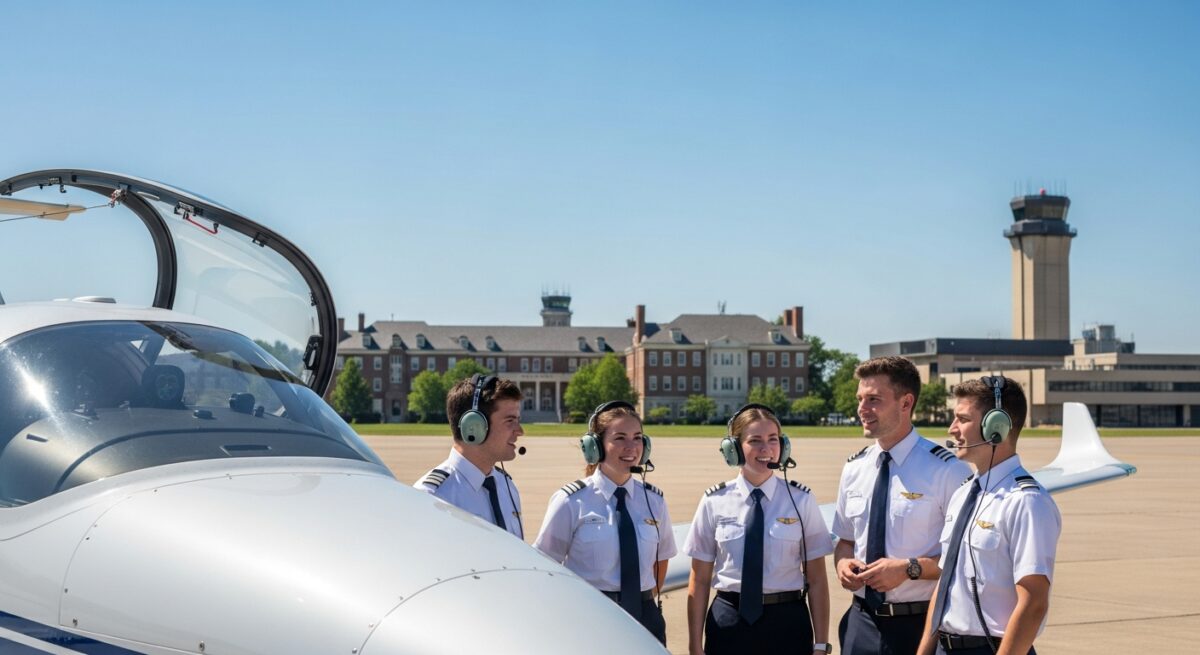
The aircraft you train in shape your skills as a pilot. The best aviation colleges invest in modern training fleets that include technologically advanced aircraft (TAA) with glass cockpits, GPS navigation, and autopilot systems. Training in these aircraft better prepares you for the transition to complex jet aircraft later in your career. Some programs offer a mix of traditional and advanced aircraft, allowing students to learn fundamentals in simpler planes before moving to more sophisticated models. Schools also vary in their simulator offerings, with some providing full-motion simulators that replicate airline flying conditions.
Top Aviation Colleges in the United States
Based on program quality, industry reputation, graduate outcomes, and student resources, the following institutions rank among the best colleges for aviation programs. Each offers unique strengths that cater to different career paths within aviation.
Embry-Riddle Aeronautical University (Daytona Beach, FL & Prescott, AZ)
Embry-Riddle is widely regarded as the premier aviation university in the world. Its Daytona Beach and Prescott campuses offer comprehensive programs in aeronautical science, aviation business administration, and aerospace engineering. The university operates a fleet of over 90 aircraft, including Cessna 172s, Piper Seminoles, and Cirrus SR20s, all equipped with modern avionics. Embry-Riddle maintains strong relationships with major airlines, including Delta, United, and Southwest, through its airline cadet programs. Graduates consistently achieve high placement rates at regional and major carriers. The school also offers extensive scholarship opportunities and dedicated career services for aviation students.
University of North Dakota (Grand Forks, ND)
The John D. Odegard School of Aerospace Sciences at UND is one of the largest and most respected aviation programs in the country. With a fleet of over 120 aircraft and multiple simulators, UND offers degrees in commercial aviation, aviation management, and air traffic control. The program benefits from its own airport and controlled airspace, providing students with real-world flying conditions. UND’s partnership with Delta Air Lines through the Delta Propel Pilot Career Path Program gives graduates a direct pipeline to the airline. The school also excels in research areas like unmanned aircraft systems and atmospheric sciences, offering interdisciplinary opportunities.
Purdue University (West Lafayette, IN)
Purdue’s School of Aviation and Transportation Technology offers a well-rounded aviation program with degrees in professional flight, aviation management, and aeronautical engineering technology. The program operates a fleet of Cessna 172s and Piper Arrows, along with advanced simulators. Purdue is known for its strong emphasis on safety management systems and human factors in aviation. The university’s proximity to Indianapolis and Chicago provides students with exposure to major aviation hubs. Purdue also offers a unique option for students to earn an MBA alongside their aviation degree through the school’s partnership with the Krannert School of Management.
Western Michigan University (Kalamazoo, MI)
WMU’s College of Aviation is one of the largest collegiate aviation programs in the nation, with a fleet of over 60 aircraft and state-of-the-art simulators. The program offers bachelor’s degrees in aviation flight science, aviation management, and aviation maintenance. WMU operates its own airport, the WMU College of Aviation at Battle Creek Executive Airport, which features a control tower and instrument approaches. The school has a strong relationship with Delta Air Lines through the Delta Propel program and also partners with regional carriers for direct hiring. WMU’s aviation alumni are well-represented at major airlines, and the program boasts high first-time pass rates on FAA checkrides.
Ohio State University (Columbus, OH)
The Center for Aviation Studies at Ohio State offers a bachelor of science in aviation with tracks in professional pilot and aviation management. The program utilizes a fleet of Cessna 172s and Piper Seminoles, along with advanced flight simulators. Ohio State’s location near Columbus’s John Glenn International Airport provides students with exposure to busy airspace and airline operations. The university’s strong engineering and business schools complement the aviation program, allowing students to pursue minors or dual degrees. Ohio State also offers a 4+1 program that allows students to earn a master’s degree in aviation in just one additional year.
Factors to Consider When Choosing an Aviation College
Beyond rankings and reputation, several practical factors should influence your decision when evaluating the best colleges for aviation programs. These considerations can significantly affect your training experience, cost, and career outcomes.
Cost is a major factor. Aviation programs are expensive, often exceeding $100,000 for a four-year degree with flight training. Tuition, flight fees, and living expenses vary widely between public universities and private institutions. Some colleges offer block tuition models that include flight training costs, while others charge per flight hour, which can lead to unpredictable expenses. Always request a detailed cost breakdown and inquire about financial aid, scholarships, and payment plans.

Weather and location directly impact training pace. Schools in sunny climates like Florida, Arizona, and California typically offer more flyable days per year, allowing students to complete training faster. However, schools in northern states often have well-structured winter operations and simulators that keep training progressing during inclement weather. Consider how the location aligns with your personal preferences and career goals.
Graduate outcomes matter. Research placement rates, average time to completion, and the types of jobs graduates secure. Schools with strong airline partnerships often provide conditional job offers before graduation. Look for programs that publish transparency data about flight training costs and completion rates.
Career Pathways in Aviation
Graduating from one of the best colleges for aviation programs opens doors to multiple career paths within the aviation industry. While becoming an airline pilot is the most common goal, aviation graduates also pursue careers in corporate aviation, flight instruction, aviation management, air traffic control, and aerospace engineering. Understanding these pathways helps you choose a program that aligns with your long-term objectives.
- Airline Pilot: The most direct path involves earning a commercial pilot license with multi-engine and instrument ratings, then building flight hours as a certified flight instructor (CFI) before moving to regional and major airlines.
- Corporate Aviation: Corporate pilots fly business jets for companies, often enjoying more predictable schedules and higher pay than regional airline pilots. Some programs offer specific training for corporate operations.
- Aviation Management: This non-flying career path focuses on airport operations, airline management, and aviation safety. Degrees in aviation management prepare graduates for roles in airport administration, airline scheduling, and regulatory compliance.
- Flight Instructor: Many aviation graduates become CFIs to build flight hours and gain experience. Top programs include dedicated CFI training courses that prepare students for this critical role.
- Aerospace Engineering: For students interested in the technical side of aviation, degrees in aerospace engineering lead to careers in aircraft design, manufacturing, and research at companies like Boeing, Airbus, and NASA.
Each career path has different educational requirements. For example, airline pilots typically need a bachelor’s degree in aviation or a related field, while aviation management roles may accept degrees in business or public administration. The best aviation colleges offer multiple degree tracks to accommodate these diverse goals.
Financial Aid and Scholarship Opportunities
Paying for aviation training is a significant concern for most students. Fortunately, many aviation colleges offer substantial financial aid packages, scholarships, and payment plans. Federal student aid, including Pell Grants and student loans, is available at accredited institutions. Additionally, many schools offer merit-based scholarships specifically for aviation students. For veterans, the GI Bill can cover tuition and flight training costs at approved institutions. Some programs also offer work-study opportunities within their flight departments, allowing students to earn money while gaining experience.
Scholarships from organizations like the Aircraft Owners and Pilots Association (AOPA), Women in Aviation International, and the Experimental Aircraft Association (EAA) provide additional funding sources. Many aviation colleges also offer institutional scholarships based on academic performance, leadership, and financial need. When researching programs, always ask about scholarship availability and deadlines.
Frequently Asked Questions
What is the difference between Part 61 and Part 141 flight training?
Part 141 schools follow a structured curriculum approved by the FAA, allowing students to obtain certain certificates with fewer flight hours (e.g., 190 hours for a commercial license instead of 250). Part 61 schools offer more flexible training schedules but require more total flight hours. Most aviation colleges operate under Part 141 because it provides a predictable training timeline and can be more cost-effective.
Do I need a college degree to become an airline pilot?
While a college degree is not legally required for an airline transport pilot certificate, most major airlines prefer or require a bachelor’s degree. Regional airlines may hire pilots with an associate degree or significant flight experience. Earning a degree from one of the best colleges for aviation programs gives you a competitive advantage in the hiring process.
How long does it take to complete an aviation degree?
A typical bachelor’s degree in aviation takes four years, though some programs offer accelerated options that can be completed in three years. Flight training timelines vary based on weather, aircraft availability, and the student’s schedule. On average, students complete all flight ratings within two to three years while pursuing their academic degree.
Can I transfer credits from another college to an aviation program?
Many aviation colleges accept transfer credits from accredited institutions, including general education courses. However, aviation-specific courses and flight training credits may not transfer as easily. Contact the admissions office of each school to discuss your specific situation. Some programs offer credit for prior military flight training or FAA certificates.
What is the job placement rate for aviation graduates?
Job placement rates vary by school and program. The top aviation colleges report placement rates of 85-95% within six months of graduation for pilot-track students, especially those with strong airline partnerships. Aviation management and aerospace engineering graduates also enjoy high placement rates due to growing demand in the industry. For more information on how veterans can leverage these programs, see our guide on Best Colleges for Veterans and Military Students in 2026.
Choosing the right aviation college is a pivotal step toward a rewarding career in the sky or on the ground. The best colleges for aviation programs combine rigorous academics, state-of-the-art training equipment, experienced instructors, and strong industry connections. By carefully evaluating your goals, budget, and preferred learning environment, you can select a program that sets you up for success. Whether you dream of flying for a major airline, managing airport operations, or designing the next generation of aircraft, the right aviation college will provide the foundation you need. Start your research early, visit campuses, and talk to current students and alumni to make an informed decision. Your aviation career begins with the right education, and the schools highlighted in this guide represent the best opportunities available today. For additional resources on degree programs and financial aid, visit CollegeDegree.School to explore your options.