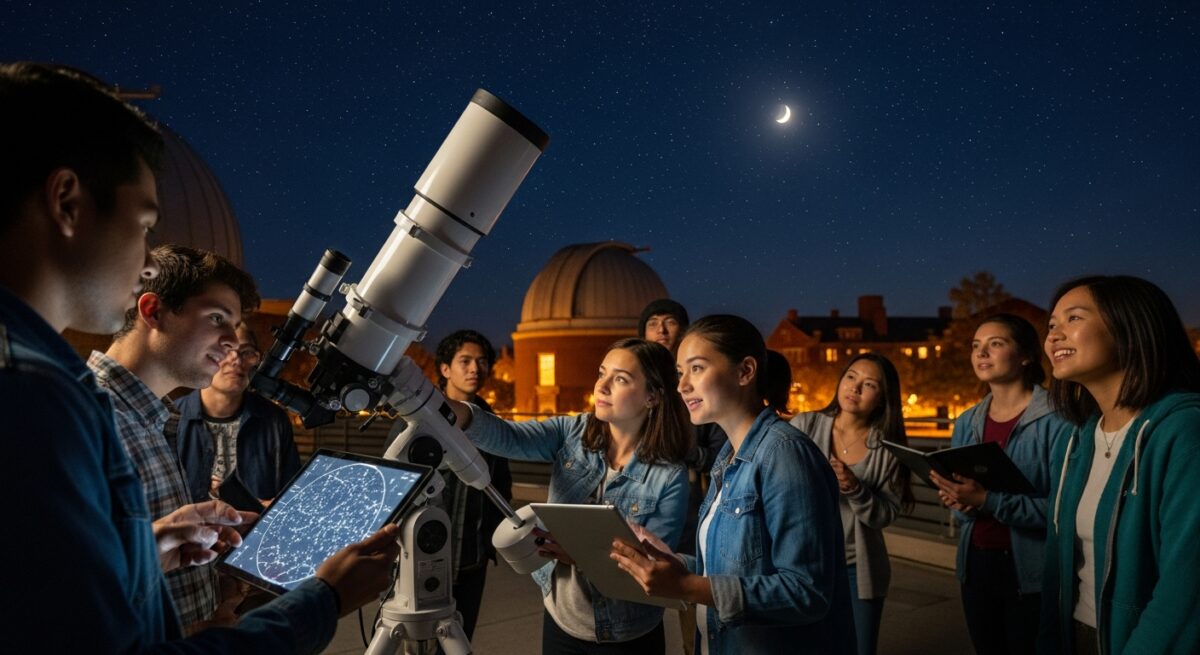
For students who have spent nights gazing at the stars and wondering about the cosmos, choosing the right undergraduate program is a critical first step toward a career in astronomy. The field combines physics, mathematics, and computer science to explore everything from black holes to the origins of the universe. But not all programs are created equal. The best colleges for astronomy programs offer strong research opportunities, access to observatories, and faculty who are active in groundbreaking discoveries. This guide walks you through the top institutions, what makes them stand out, and how to choose the program that fits your goals.
What Defines a Top Astronomy Program
When evaluating astronomy colleges, you need to look beyond just the name of the school. The strongest programs share several key characteristics that directly affect your education and career trajectory. Research access is paramount. Top programs operate their own observatories or have partnerships with major facilities like the Keck Observatory or the Very Large Array. They also offer undergraduate research experiences that let you work alongside professors on real projects, not just textbook problems.
Another critical factor is faculty expertise. The best colleges for astronomy programs have professors who are leaders in fields like exoplanet detection, stellar astrophysics, and cosmology. You want a department where you can find mentors whose work excites you. Curriculum depth also matters. Look for programs that offer a strong foundation in physics and math, plus specialized courses in astrophysics, computational methods, and observational techniques. Finally, consider the size of the department. Smaller programs may offer more personalized attention, while larger ones provide a wider range of courses and facilities.
Top Tier Research Universities for Astronomy
California Institute of Technology (Caltech)
Caltech consistently ranks among the best colleges for astronomy programs worldwide. Its Division of Physics, Mathematics and Astronomy offers an undergraduate astronomy option that is intensely research focused. Students have direct access to the Palomar Observatory and work closely with faculty from the Jet Propulsion Laboratory (JPL). The curriculum is rigorous, requiring a deep foundation in physics and advanced mathematics. Caltech graduates frequently go on to top graduate programs or directly into research roles at observatories and space agencies. The small student body means close mentorship, but the workload is demanding. For students who thrive on challenge and want to be at the frontier of discovery, Caltech is an exceptional choice.
Princeton University
Princeton’s Department of Astrophysical Sciences is one of the oldest and most respected in the country. The undergraduate program leads to a Bachelor of Arts in Astrophysical Sciences, with a curriculum that integrates physics, math, and computer science from the start. Princeton owns and operates the Peyton Hall observatory on campus, and students also have access to the Apache Point Observatory in New Mexico. A distinctive feature is the senior thesis, a yearlong independent research project that many students publish in scientific journals. Princeton’s strength lies in its balance of rigorous classroom instruction and hands-on research. Graduates are well prepared for PhD programs or careers in data science and aerospace.
University of California, Berkeley
UC Berkeley’s Department of Astronomy is part of a world-class research university with a vibrant astronomy community. The undergraduate program offers both a Bachelor of Arts and a Bachelor of Science in Astrophysics. Berkeley operates the Leuschner Observatory and has strong ties to the Space Sciences Laboratory and the Berkeley SETI Research Center. Students benefit from the department’s location in the San Francisco Bay Area, which provides internship opportunities at companies like Google and NASA Ames. The program emphasizes computational astrophysics, and many courses incorporate Python programming and data analysis. Berkeley is ideal for students who want a large university experience with cutting-edge research and diverse course offerings.
Liberal Arts Colleges with Strong Astronomy Programs
Not all top astronomy programs are at large research universities. Several liberal arts colleges offer exceptional astronomy education with a focus on undergraduate teaching and close faculty mentorship. These schools often provide research opportunities that rival larger institutions, but with smaller class sizes and a supportive community. For students who value personalized attention and a broad education, these colleges are among the best colleges for astronomy programs.
Williams College
Williams College in Massachusetts has a renowned astronomy program within its physics department. The college operates the Hopkins Observatory, one of the oldest in the country, and the Milham Planetarium. Undergraduates can engage in research from their first year, working with faculty on projects in stellar astronomy, galactic structure, and instrumentation. Williams sends a high percentage of its astronomy graduates to top PhD programs. The college’s small size ensures that every student gets hands-on experience with telescopes and data analysis. The focus is on developing strong problem-solving skills and scientific communication.
Swarthmore College
Swarthmore’s Department of Physics and Astronomy is known for its collaborative research culture. The college operates the Swarthmore College Observatory, which is used for both teaching and research. Students have opportunities to work with data from the Spitzer Space Telescope and the Kepler mission. A standout feature is the summer research program, where students receive stipends to work full-time on faculty-led projects. Swarthmore’s emphasis on undergraduate research and its strong track record of placing students in PhD programs make it a top choice for serious astronomy students.
Specialized Programs in Astronomy and Astrophysics
Some universities offer unique specialized tracks that combine astronomy with other fields like planetary science, aerospace engineering, or data science. These programs are ideal for students with specific career goals. For example, the University of Arizona has a strong program in planetary astronomy, leveraging its proximity to the Steward Observatory and the Lunar and Planetary Laboratory. Students can specialize in planetary geology or exoplanet atmospheres. Similarly, the Massachusetts Institute of Technology (MIT) offers a flexible astrophysics major that allows students to combine astronomy with courses in aerospace engineering or computer science. MIT’s connection to the Kavli Institute for Astrophysics and Space Research provides unparalleled research opportunities.

When exploring astronomy colleges, consider programs that offer certificates or minors in related areas like astrobiology or scientific computing. These add depth to your degree and make you more competitive in the job market. Some schools also offer combined bachelor’s and master’s programs, allowing you to complete advanced coursework in five years. This is a smart option if you plan to pursue a PhD.
How to Choose the Right Astronomy Program for You
Selecting from the best colleges for astronomy programs requires careful self-assessment and research. Here are key factors to evaluate:
- Research opportunities: Does the program offer undergraduate research for credit or pay? Are there summer internships or REU (Research Experiences for Undergraduates) programs?
- Facilities and equipment: Does the school have its own observatory? Do students get to use professional-grade telescopes and software?
- Faculty mentorship: Are professors accessible to undergraduates? Do they have active research programs that include students?
- Career outcomes: Where do graduates go? Do they get into top graduate schools or find jobs in the space industry?
- Curriculum flexibility: Can you double major in physics or computer science? Are there elective courses in planetary science or cosmology?
Visiting campuses and talking to current students can also provide valuable insight. Reach out to the department and ask to sit in on a class or tour the observatory. Many schools offer virtual tours and information sessions for prospective students. Remember that the best program for you depends on your learning style, career goals, and personal preferences.
Financial Considerations and Scholarships
Astronomy programs at top universities can be expensive, but there are many ways to make them affordable. Many private colleges offer generous need-based financial aid. Public universities often have lower tuition for in-state students. Scholarships specifically for astronomy students are available from organizations like the American Astronomical Society and the National Science Foundation. Additionally, many research universities offer paid summer research positions that can help cover living expenses. For more guidance on navigating the financial side of higher education, you can explore resources at collegeandtuition.com for tips on scholarships and tuition planning.
Frequently Asked Questions
What GPA and test scores do I need for top astronomy programs?
Competitive programs typically expect a high school GPA of 3.7 or higher and strong SAT or ACT scores. However, many schools have become test-optional. More important is a strong background in math and science courses, including calculus and physics.
Can I become an astronomer with a degree from a liberal arts college?
Yes. Many successful astronomers earned their bachelor’s degrees from liberal arts colleges like Williams, Swarthmore, or Carleton. These programs provide excellent preparation for PhD programs because of their focus on research and critical thinking.
Is it better to major in astronomy or physics for graduate school?
Both are acceptable. A physics major with astronomy electives can be just as strong as an astronomy major. The key is to take advanced courses in electromagnetism, quantum mechanics, and statistical mechanics, as these are essential for graduate-level astronomy.
What careers are available with a bachelor’s in astronomy?
Graduates work in data science, aerospace engineering, science communication, and education. Many also pursue graduate degrees in astronomy or related fields. The analytical and computational skills learned are highly valued in many industries.
Making Your Decision
Choosing from the best colleges for astronomy programs is a personal decision that depends on your academic interests, career goals, and financial situation. Focus on programs that offer strong research opportunities, supportive faculty, and a curriculum that challenges you. Visit campuses when possible, talk to professors and students, and trust your instincts. A well-chosen astronomy program can open doors to a lifetime of discovery and a rewarding career exploring the universe. The effort you put into researching and selecting the right school will pay off in the education and experiences you gain.