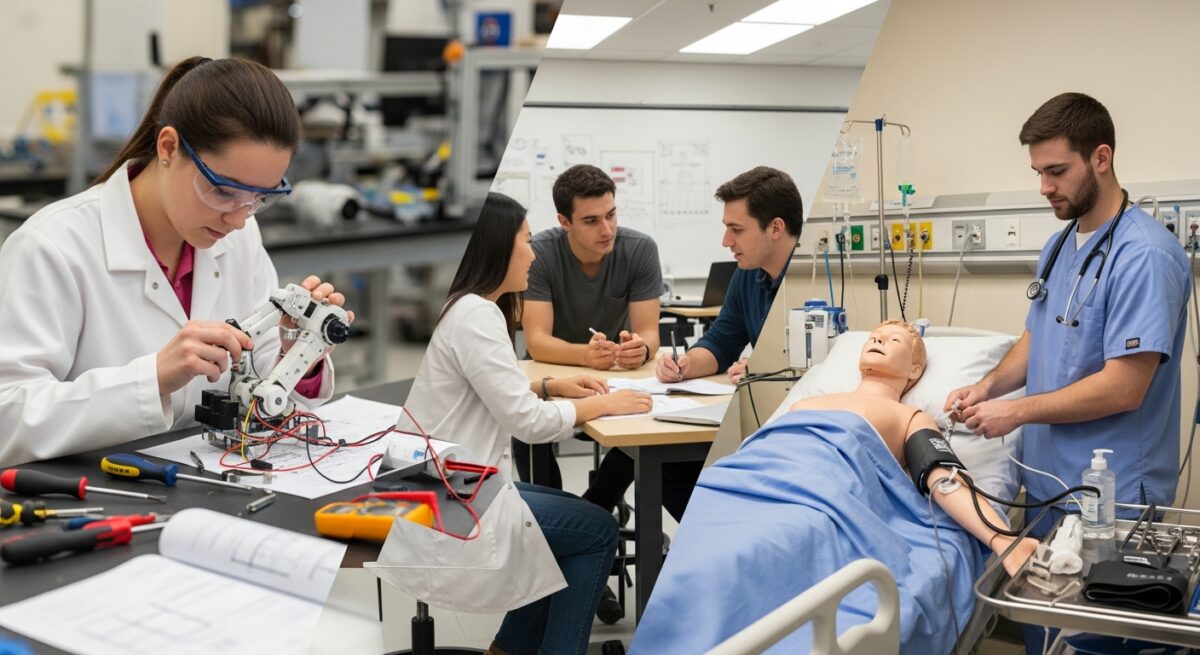
For many students, the thought of spending four years primarily in lectures and writing papers feels disconnected from their goals. They thrive by doing, building, creating, and solving tangible problems. If you learn best through action and application, you are not alone, and the modern higher education landscape has evolved to meet your needs. A wide array of college degrees for hands-on learners now seamlessly integrate theory with intensive practice, preparing graduates for immediate impact in high-demand fields. These programs are built around labs, studios, clinical rotations, fieldwork, and capstone projects, ensuring that your education is an active, engaging process that directly correlates to professional success.
What Defines a Hands-On Degree Program?
Not all degrees are created equal when it comes to practical application. A truly hands-on program is characterized by a curriculum designed around experiential learning. This means the majority of your credit hours will be earned not in a traditional lecture hall, but in environments that simulate real-world work. Key components include laboratory sessions where you practice scientific techniques, studio time for artistic creation, clinical placements for healthcare skills, workshops for technical trades, and field research for environmental studies. The assessment in these programs often shifts from purely written exams to portfolio reviews, project demonstrations, practicum evaluations, and performance-based testing.
This pedagogical approach aligns with several educational theories, but its primary benefit is unambiguous: employability. Employers consistently report valuing graduates who can apply knowledge from day one. Hands-on degrees build not just knowledge, but also the muscle memory, problem-solving instincts, and professional confidence that come from repeated practice. This is why many of these programs maintain strong advisory boards with industry leaders, ensuring that the tools, techniques, and technologies taught are current and relevant. When exploring college degrees for hands on learners, look for programs that highlight these experiential components in their course descriptions and boast high job placement rates for graduates.
High-Impact Hands-On Degree Paths
The spectrum of hands-on degrees is vast, spanning STEM, healthcare, creative arts, and skilled professions. Each path offers a direct route to a career where your daily work involves active engagement and tangible results.
Engineering and Engineering Technology
Engineering is the quintessential hands-on field for systematic problem-solvers. Degrees in Mechanical, Civil, Electrical, and Computer Engineering are built on a foundation of physics, math, and design, but they come alive in the lab. Students spend countless hours building prototypes, testing materials in strength labs, programming robotics, and working on team-based design projects. A closely related and often even more applied alternative is Engineering Technology. These programs focus on the implementation and application of engineering principles rather than deep theoretical development. Graduates often work alongside engineers, specializing in areas like manufacturing processes, electronics, or construction management. The curriculum is intensely practical, involving hands-on work with the actual tools and systems used in industry.
Health Sciences and Clinical Professions
Healthcare is fundamentally a hands-on domain. Degrees such as Nursing (BSN), Radiologic Technology, Respiratory Therapy, and Surgical Technology are structured around clinical rotations. From early in the program, students are in hospitals, clinics, and labs, practicing patient care under supervision. For instance, our resource on the best hands-on college degrees for high-demand careers details how nursing students complete hundreds of clinical hours, mastering skills from patient assessment to complex procedures. Other paths, like Medical Laboratory Science, involve diagnosing diseases through hands-on microscope and culture work. These programs lead to licensure or certification, and their entire design is focused on competent, safe, practical application.
Computer Science and Information Technology
While it may seem screen-based, modern Computer Science and IT degrees are highly applied. The hands-on component is coding, building software, configuring networks, and managing databases. Project-based learning is standard: you might build a mobile app in one course, a full-stack web application in another, and participate in a cybersecurity capture-the-flag competition in a third. Many programs incorporate internships with tech companies or require a significant senior capstone project for a real client. This iterative process of writing, testing, debugging, and deploying code is a deeply practical skill set. Specializations like Software Engineering, Cybersecurity, and Network Administration are particularly focused on applied outcomes and industry-recognized certifications.
Skilled Trades and Applied Sciences
Four-year degrees also exist in fields traditionally associated with trade schools. Construction Management, Aviation Science (for pilots), Automotive Engineering Technology, and Welding Engineering are bachelor’s programs that combine management and theory with extensive shop, hangar, or site time. Similarly, degrees in Agriculture, Forestry, and Environmental Science are field-heavy. Students conduct soil and water sampling, manage crops, use GIS technology for land mapping, and participate in wildlife conservation projects. These programs answer a critical need for highly trained professionals who can manage complex systems and lead teams in technical environments.
The Creative and Design Disciplines
For hands-on learners with artistic inclinations, numerous degrees turn creativity into a profession through constant practice. A Bachelor of Fine Arts (BFA) in disciplines like Graphic Design, Animation, Illustration, or Ceramics is a studio-intensive commitment. Students spend most of their class time creating work, receiving critique, and refining their craft. Architecture is another profoundly hands-on design field, involving physical model-making, digital rendering, and material studies. Film Production degrees have students writing, shooting, directing, and editing films from their first year. These programs are built on the premise that expertise comes from continuous doing and iteration, culminating in a professional portfolio that serves as your career launchpad.
Choosing the Right Program: Key Evaluation Criteria
Identifying a degree that matches your hands-on learning style requires looking beyond the general program title. You must investigate the specific curriculum and resources of each school. Start by scrutinizing the course catalog. What percentage of credits are dedicated to labs, studios, practicums, or clinicals? Look for required internship or co-op components, as these are gold standards for applied learning. Investigate the facilities: are there modern engineering labs, simulation hospitals, professional-grade studios, or dedicated workshop spaces? The quality of these resources directly impacts your experience.
Faculty background is equally crucial. Instructors who have worked extensively in the industry bring real-world context and connections. Finally, examine the program’s outcomes. What are the licensure exam pass rates (for healthcare fields)? What companies hire graduates? A strong career services office with industry partnerships is a vital sign. Remember, the goal is to find a program where doing is not an add-on, but the core methodology. For a broader perspective on academic pathways, you can explore our analysis of what are the easiest college degrees to earn, which considers factors like course structure that may appeal to different learning styles.
Here are the essential factors to evaluate when researching hands-on programs:
- Curriculum Balance: The ratio of lecture credits to lab/studio/clinical credits.
- Required Experiential Components: Mandatory internships, co-ops, practicums, or clinical hours.
- Facility Quality: Access to industry-standard equipment, software, labs, and workspaces.
- Faculty Expertise: Professors with current or recent professional experience in the field.
- Career Outcomes: Job placement rates, starting salaries, and employer partnerships.
After identifying potential programs, the next step is understanding how to fund this practical education. Hands-on degrees can sometimes involve additional costs for lab fees, materials, tools, or travel to clinical sites. It is essential to factor these into your financial planning. Exploring all avenues of financial aid, including specialized scholarships for technical and applied fields, is crucial. Students can find valuable support through a dedicated scholarship information resource to help navigate funding options for these impactful degree paths.
Beyond the Bachelor’s: Career Trajectories and Advancement
The career paths stemming from hands-on degrees are typically clear and in demand. Graduates often move directly into technical, clinical, or creative roles. An Electrical Engineering Technologist might become a controls systems designer, a Nursing graduate enters a hospital residency, and a Graphic Design BFA holder joins a marketing agency. The applied nature of the degree means less employer training is required, a significant advantage. Advancement often comes through experience, specialized certifications, or moving into supervisory or management roles. Some graduates may later pursue master’s degrees, which for hands-on fields are also frequently applied, like a Master of Science in Nursing to become a nurse practitioner or a Master of Engineering Management.
The economic resilience of these fields is generally high. Societies always need people who can build infrastructure, provide healthcare, maintain technology, and create design solutions. This translates to strong job security and competitive compensation. Furthermore, the satisfaction derived from seeing the direct results of your work, whether it’s a healed patient, a functioning bridge, a secure network, or a published design, provides a level of professional fulfillment that purely theoretical work may not. Choosing one of the many excellent college degrees for hands on learners is an investment in a career defined by action, impact, and continuous engagement.
If you learn by doing, your college journey should be built on that foundation. The right hands-on degree transforms education from passive absorption into active creation, equipping you with the skills, confidence, and portfolio to thrive from your first day on the job. By prioritizing programs where application is central, you align your education with your innate strengths, paving the way for a dynamic and rewarding career.