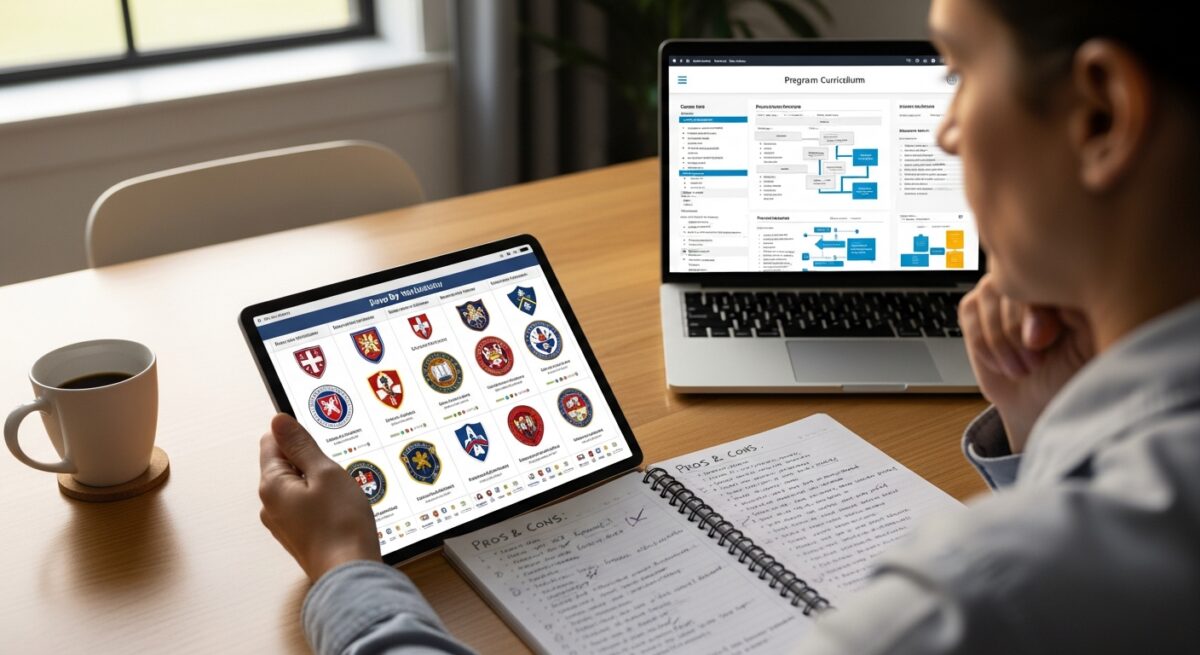
Choosing an online master’s degree is a pivotal decision that can redefine your career trajectory and intellectual growth. Yet, with a seemingly endless list of universities offering virtual programs, the selection process can feel overwhelming. A rushed or poorly informed choice can lead to misaligned expectations, wasted resources, and frustration. The key to navigating this complex landscape is not just to look for a program, but to conduct a meticulous, multi-faceted online master’s program comparison. This deliberate process shifts your search from a passive review of websites to an active, strategic evaluation, ensuring your investment of time, money, and energy yields the maximum possible return in knowledge, credentials, and opportunity.
The Foundational Pillars of Accreditation and University Reputation
Before you delve into curriculum specifics or tuition costs, your first and most critical filter must be accreditation. This non-negotiable element is the bedrock of educational quality and professional recognition. Attending a regionally accredited institution ensures that your degree will be respected by employers, other academic institutions, and licensing bodies. National accreditation, while legitimate, is often held by for-profit or vocational schools and may not carry the same weight for certain graduate-level pursuits or if you plan to transfer credits. Always verify accreditation status directly on the U.S. Department of Education or Council for Higher Education Accreditation (CHEA) websites, not just the school’s own marketing materials.
Closely tied to accreditation is the broader reputation of the university and its specific college or department. For a graduate degree, the prestige of the program within your field can significantly impact networking opportunities and career advancement. Research the faculty’s expertise, their publication records, and their industry connections. Does the program have advisory boards with industry leaders? Are there notable alumni in positions you aspire to? A degree from a well-regarded program, such as those highlighted in our overview of University of Pennsylvania online masters programs, often carries a tangible professional currency that extends far beyond the virtual classroom.
Curriculum Structure and the Realities of Online Learning Delivery
The core of any master’s program is its curriculum, but in the online space, how the material is delivered is as important as what is delivered. Start by scrutinizing the required courses and electives. Do they align with your specific career goals, whether that’s moving into data science, advanced healthcare administration, or educational leadership? Look for programs that offer specializations or concentrations that match your niche interests.
Next, you must understand the learning modality. Programs typically fall into two categories: asynchronous and synchronous. Asynchronous programs allow you to complete coursework on your own schedule within set deadlines, offering maximum flexibility for working professionals. Synchronous programs require you to log in for live, scheduled classes via video conferencing, fostering real-time interaction but demanding a fixed time commitment. Many programs use a hybrid model. Additionally, examine the technology platform used (e.g., Canvas, Blackboard) and see if you can access a demo. Consider the following practical elements that directly affect your daily experience:
- Course Interaction: How are discussions facilitated? Are they through text-based forums, video responses, or live chats?
- Assignment Types: Does the program rely heavily on traditional papers, or does it incorporate practical projects, simulations, and portfolio development?
- Capstone or Thesis Requirements: Does the program culminate in a significant research project or applied practicum that can serve as a showcase for future employers?
- Technical Support: What resources are available for students, and are they accessible 24/7?
This deep dive into structure will prevent the common pitfall of enrolling in a program with a learning style that clashes with your habits and lifestyle. For a broader framework on evaluating these delivery models, our guide on how to compare web-based programs offers a detailed checklist.
Evaluating the True Cost and Financial Considerations
Tuition is the most obvious cost, but an effective online master’s program comparison must account for the total financial picture. Universities can price online degrees in various ways: per credit hour, per course, or as a flat-rate program fee. When comparing, always calculate the total cost for the entire degree based on the required number of credits. Be wary of fees that can add thousands of dollars to the bottom line. Common fees include technology fees, graduation fees, distance learning fees, and proctored exam fees. A transparent program will list these clearly.
Beyond the invoice, investigate the availability of financial aid. Many online students are eligible for federal student loans, but you should also explore program-specific scholarships, graduate assistantships, employer tuition reimbursement partnerships, and military benefits. Some institutions offer lower tuition rates for online students regardless of residency, while others charge a premium. Create a spreadsheet that lists not only the total tuition and fees but also the availability of aid and potential hidden costs like required textbooks or software licenses. This comprehensive view will allow you to weigh the value proposition of each program accurately, not just the sticker price.
Student Support and Career Outcomes Analysis
The isolation of online learning makes robust student support services paramount to success. A superior program provides dedicated resources tailored for its virtual learners. During your research, inquire about the following support structures: Is there a dedicated online student advisor or success coach? What is the process for accessing online library resources, writing centers, and tutoring? Is there an active online student community or mentorship program? The presence of these services often correlates with higher retention and graduation rates.
Perhaps the most telling metric of a program’s value is the career outcomes of its graduates. Reputable programs will publish or provide upon request data on graduation rates, job placement rates, and average salary increases. Connect with the program’s career services office and ask specific questions: Do they offer virtual career counseling, resume reviews for online students, and host online job fairs? Do they have strong relationships with employers in your target industry? A program that invests in comprehensive career support demonstrates a commitment to your long-term success, transforming the degree from an academic achievement into a career catalyst.
The Final Checklist for Your Informed Decision
After gathering data across all these dimensions, the final step is a structured synthesis. Create a personalized scoring matrix. List your top 3-5 programs as rows and the critical criteria as columns: Accreditation Status, Curriculum Relevance, Cost/Financial Aid, Delivery Format, Faculty Expertise, Student Support, and Career Outcomes. Assign a weight to each criterion based on your personal priorities (e.g., cost might be 30%, curriculum 40%). Score each program on a scale, multiply by the weight, and sum the totals. While not purely scientific, this exercise forces you to move beyond gut feeling and make a quantified, objective comparison.
Finally, take the initiative to connect directly with the programs. Attend virtual open houses, schedule calls with admissions counselors, and, most importantly, request to speak with a current student or recent alumnus. Their firsthand insights about workload, professor responsiveness, and the overall student experience are invaluable. They can confirm or contradict the official narrative and provide the nuanced context that brochures and websites cannot.
Conducting a thorough online master’s program comparison is an investment in itself, requiring diligence, introspection, and research. However, this rigorous approach is what separates a satisfactory educational experience from a transformative one. By systematically evaluating accreditation, curriculum, cost, support, and outcomes, you shift from being a passive consumer to an empowered decision-maker. The right program is not merely the highest-ranked or the least expensive; it is the one that aligns perfectly with your professional objectives, learning style, and personal circumstances, setting the stage for meaningful advancement and lifelong impact.