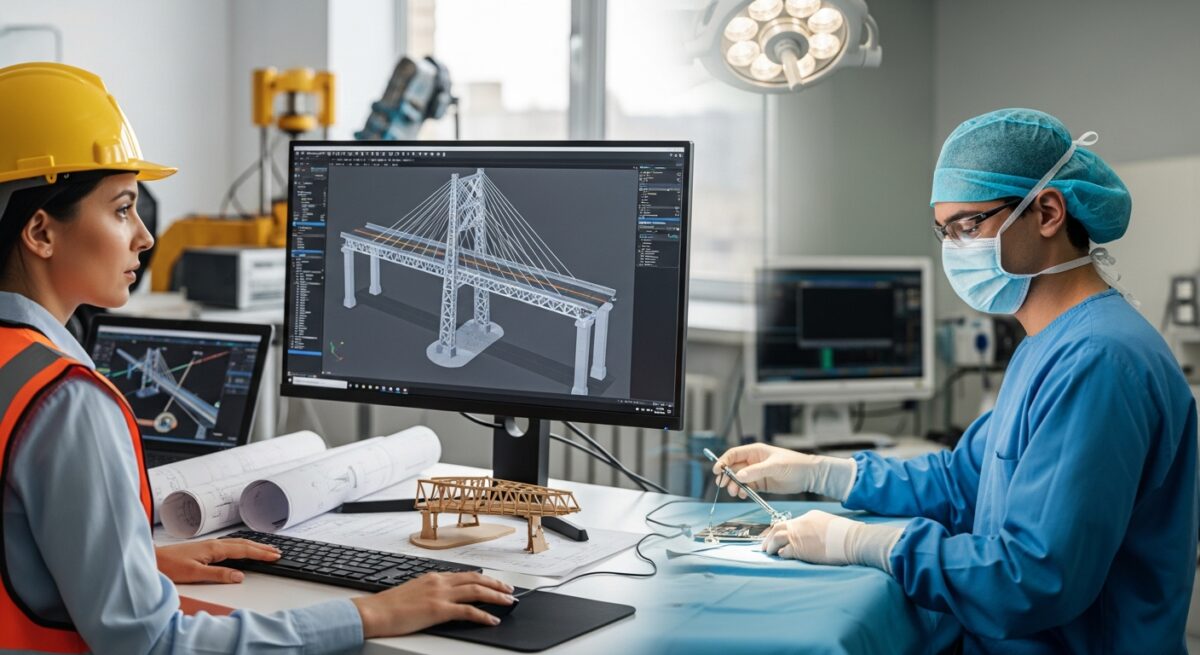
Choosing a college major is a defining decision, one that sets the trajectory for your career, income, and daily life. Two of the most respected and challenging paths are healthcare and engineering. Both promise stability, strong earning potential, and the opportunity to solve complex problems, yet they lead to fundamentally different professional worlds. The core choice between a healthcare vs engineering degree isn’t just about subjects, it’s about aligning with your innate strengths, values, and vision for your future work. This guide breaks down the critical differences in skills, day-to-day life, career paths, and personal fit to help you make an informed decision.
Core Distinctions: The Nature of the Work
At their heart, healthcare and engineering professions solve different types of problems for different beneficiaries. Healthcare is inherently human-centric and biological. Whether you become a physician, nurse, therapist, or healthcare administrator, your primary focus is on individual patients, populations, or biological systems. The work involves diagnosing illness, providing care, managing health outcomes, and navigating the complexities of human biology and emotion. Success requires not only scientific knowledge (biology, chemistry, anatomy) but also exceptional interpersonal skills, empathy, and the ability to make decisions under emotional pressure.
Engineering, in contrast, is fundamentally systems-centric and physical. Engineers design, build, analyze, and maintain structures, machines, devices, software, and processes. They apply principles of physics, mathematics, and material science to create solutions that meet specific technical requirements, often with a focus on efficiency, safety, and functionality. While many engineering projects ultimately benefit people (safer bridges, medical devices, clean water systems), the direct day-to-day work is with systems, data, code, and materials. The primary skills are analytical reasoning, mathematical modeling, logical problem-solving, and technical design.
Academic Pathways and Rigor
Both fields demand rigorous academic preparation, but the structure and focus of the curricula differ significantly. An engineering degree, such as in mechanical, civil, electrical, or computer engineering, is built on a heavy foundation of advanced mathematics (calculus, differential equations), core physical sciences (physics, chemistry), and intensive engineering science courses. The curriculum is highly sequential, with each semester building directly on the last. Projects often involve team-based design work, laboratory experiments, and computer simulations.
A healthcare degree path varies more widely depending on the ultimate career goal. Pre-medical or pre-nursing tracks also require deep science coursework (biology, organic chemistry, biochemistry) but with a life sciences focus. However, many healthcare roles have distinct academic routes. For example, nursing has its own dedicated Bachelor of Science in Nursing (BSN) program blending science with clinical practice. Other paths, like healthcare administration or public health, may sit within business or policy schools, requiring a mix of science, management, and social science courses. The healthcare vs engineering major debate often hinges on this question: are you drawn more to the laws of physics and calculus, or to the complexities of biology and organic chemistry?
Licensure, Certification, and Further Education
A major differentiator is the role of licensure. In engineering, while becoming a licensed Professional Engineer (PE) enhances authority and career prospects (especially in civil engineering), many engineers work successfully without it, particularly in software and industry roles. In healthcare, licensure or board certification is almost always mandatory to practice clinically. You cannot be a practicing nurse, physician, physical therapist, or pharmacist without passing a rigorous national or state exam after your degree. This creates a non-negotiable, high-stakes barrier to entry. Furthermore, many high-level healthcare roles require advanced degrees (MD, DPT, PharmD, Master of Public Health), meaning a longer and more expensive educational journey is often a prerequisite. For those seeking flexibility, exploring online education resources can be invaluable for prerequisite courses or graduate programs in fields like healthcare administration.
Career Trajectories and Daily Life
The day-to-day reality of these careers could not be more different. A healthcare professional’s environment is typically clinical: hospitals, clinics, laboratories, or community health centers. The work is often shift-based (including nights, weekends, and holidays), fast-paced, and involves direct, sometimes high-stakes, interaction with patients and families. Stress can be emotional and physical, stemming from human suffering, urgent decisions, and long hours on one’s feet.
An engineer is more likely to work in an office, a lab, a manufacturing plant, or at a construction site. Work often follows a more standard business-week schedule, though project deadlines can demand extra hours. Collaboration happens with other engineers, project managers, technicians, and clients. The stress is more often project-driven, related to budgets, deadlines, design failures, or technical problem-solving. The following list highlights key environmental contrasts.
- Work Setting: Hospital/Clinic vs. Office/Factory/Site
- Primary Interaction: Patients/Care Teams vs. Engineers/Clients/Data
- Pace & Rhythm: Reactive (patient needs) vs. Project-Based (milestones)
- Stress Type: Emotional/Urgent vs. Technical/Deadline-Driven
Career growth also diverges. Engineering offers a relatively clear technical or management ladder within corporate or government structures. Healthcare offers parallel tracks: clinical advancement (e.g., nurse to nurse practitioner, specialist physician), research, hospital administration, or public policy. The earning potential is high in both, but peak earnings in specialized surgical fields or certain engineering tech leadership roles can outpace the other, though often with proportional increases in responsibility, education cost, and stress.
Key Personal Attributes for Success
Your personality and intrinsic motivations are perhaps the most critical filters for this decision. Ask yourself which set of descriptors resonates more deeply. A strong fit for healthcare often includes a deep-seated desire to help and connect with people directly, high emotional intelligence, resilience in the face of human suffering, comfort with ambiguity (biology is not always an exact science), and stellar communication skills. You must be a lifelong learner as medical knowledge evolves rapidly.
A strong fit for engineering leans toward a passion for understanding how things work, a love for mathematical and logical puzzle-solving, meticulous attention to detail, systematic thinking, and creativity within constraints. While teamwork is essential, much engineering work also involves deep, independent focus. Patience for iterative testing, failure analysis, and long project cycles is crucial. If the thought of deriving equations or debugging code for hours sounds engaging rather than tedious, engineering may be your calling.
Converging Fields and Future Outlook
The lines between healthcare and engineering are blurring in exciting areas, creating hybrid careers. Biomedical engineering is the most direct bridge, applying engineering principles to medical problems (prosthetics, imaging devices). Health informatics and data science use engineering-driven data analysis to improve patient care and hospital operations. Telemedicine relies on software engineers and network specialists. These intersections mean that a degree in one field can sometimes lead to work in the other, especially at the graduate level. The future demand for both sectors remains robust, driven by aging populations (healthcare) and technological advancement (engineering). However, automation trends differ: engineering tasks related to design and analysis may see more AI augmentation, while healthcare roles requiring human empathy, complex decision-making, and manual dexterity are likely to remain uniquely human-centric.
Ultimately, the choice between a healthcare vs engineering degree is a choice between two powerful ways to impact the world: through direct human service or through the creation of the systems and technologies that underpin modern life. Reflect on your reactions to the daily realities, the academic subjects that energize you, and the core strengths you wish to employ. Shadow professionals, take introductory courses, and speak to advisors. By understanding these career fits deeply, you can invest your educational journey in a path that aligns not just with the job market, but with your identity and purpose.